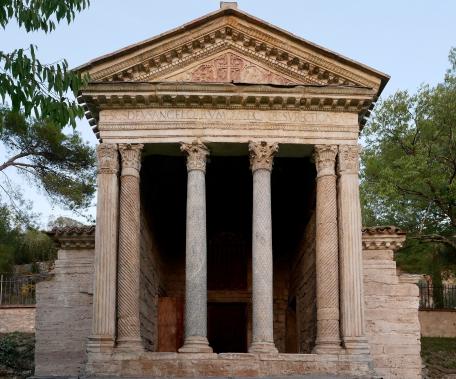


In the heart of Umbria, along the ancient Via Flaminia linking Spoleto to Trevi, lies Campello sul Clitunno—a place where millennia of history intertwine among olive-covered hills and the green reflections of the Sources of Clitunno Nearby stands the Temple of Clitunno, one of the most important Early Medieval monuments in Umbria, included among the seven Italian Lombard sites recognized in 2011 as a UNESCO World Heritage Site within the serial property “The Lombards in Italy. Places of Power (568–774 AD)”.
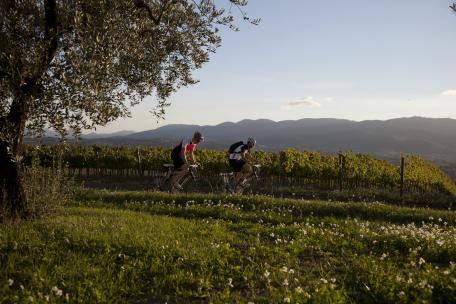
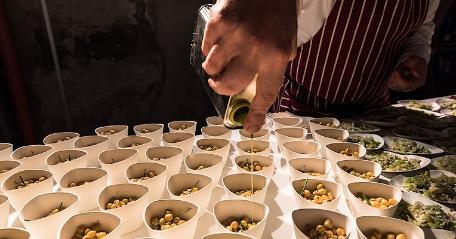
Today, Campello is also known as a City of Olive Oil, thanks to an olive-growing heritage that stretches back through the centuries. The extra-virgin olive oil produced on these hills is not merely a product, but a symbol of identity—an account of the land and of the hands that for generations have cared for these green witnesses of history, set like gems within the Fascia Olivata.
From Roman splendour to the age of castles
The earliest evidence of human presence in this area dates to the Neolithic, but it was during the Bronze Age that the territory took on greater importance, as shown by the Castelliere di Monte Serano, an ancient fortified village overlooking the Clitunno valley.
With Roman rule, the land between Spoletium and Trebiae became known especially for a major sanctuary erected near the river’s springs and dedicated to the god Jupiter Clitumnus.
After the fall of the Roman Empire, the region experienced centuries of instability and new dominations. The Lombards, who arrived in Italy in the 6th century, incorporated the area into the powerful Duchy of Spoleto, transforming these hills into a strategic defensive system dotted with numerous fortresses.
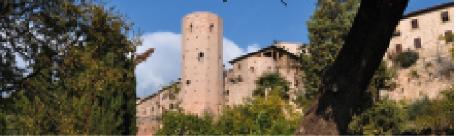
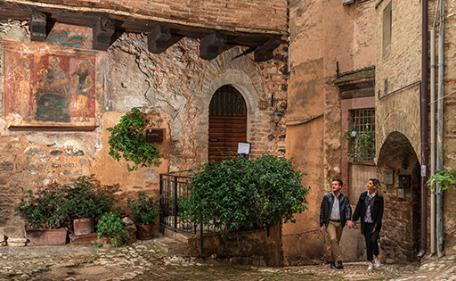
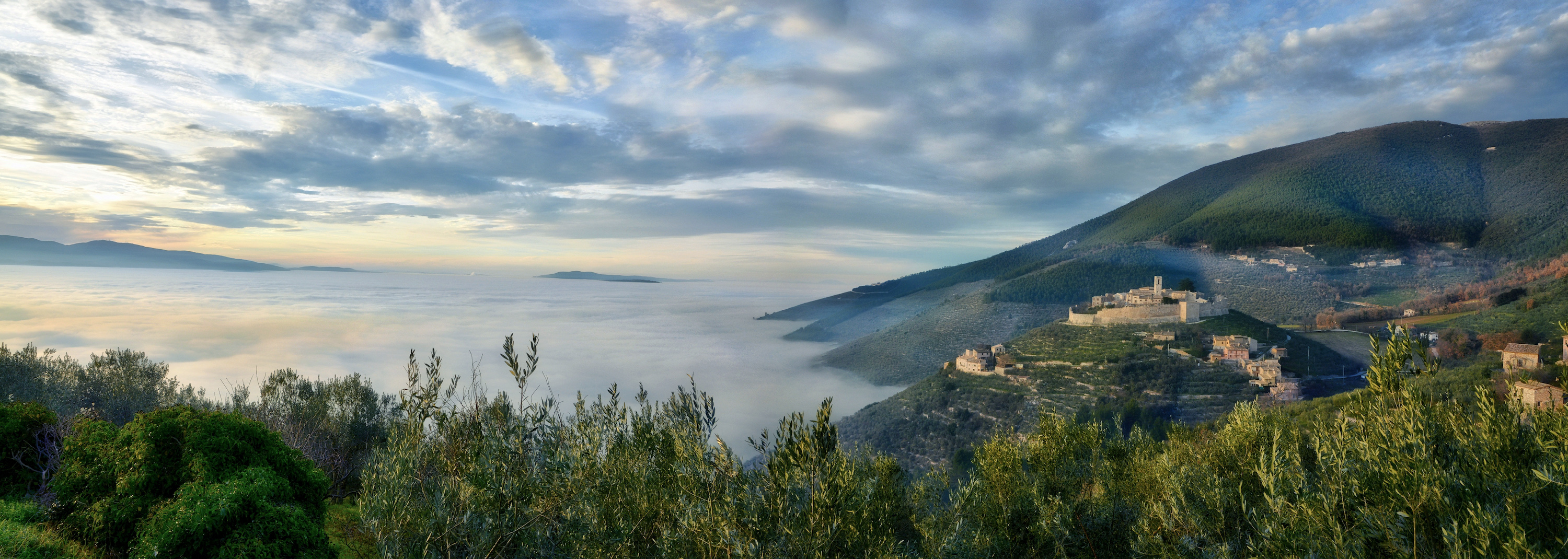
The main centre became Campello Alto, founded in the 10th century by the noble Rovero di Champeaux, a Frankish knight who followed Duke Guido of Spoleto. From the hilltop, the fortress—still encircled by its circular walls—overlooked the entire valley. At its heart stands the Church of San Donato, with its simple Romanesque elegance, while not far away rises the Barnabite Fathers’ Convent, founded in the 17th century from the union of two ancient Benedictine monasteries.
At the foot of the hill, in the 16th century, the settlement of Campello Basso developed. It was later renamed La Bianca, after the Sanctuary of the Madonna della Bianca, built by the people of Campello in 1516 to preserve a miraculous image of the Madonna and Child depicted with exceptionally fair skin.
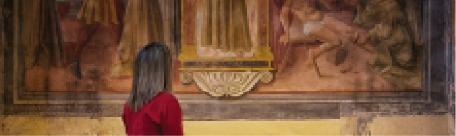
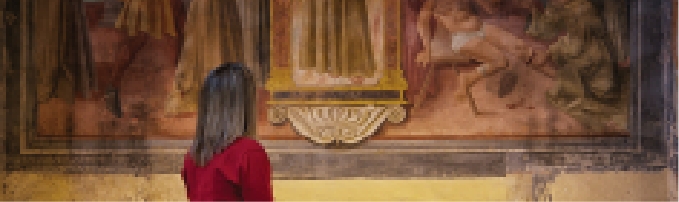
Along the Via Flaminia lie the remains of the Church of Saints Cyprian and Justina, built by the Benedictines between the 11th and 12th centuries and later used as a cemetery in the 19th century. Not far away, the Oratory of San Sebastiano, built between 1522 and 1528 as a votive offering to thank the saint after a plague, preserves a cycle of frescoes representing its patron saint.
Villages and fortresses: a landscape of stone and silence
The territory of Campello is dotted with numerous medieval fortifications. Among them, Pissignano stands out, with its hillside castle dominating the slope where, between the 11th and 12th centuries, a settlement developed around the Church of San Benedetto, part of a Benedictine monastic complex. At the edge of the village rises the Church of Santa Maria della Misericordia, known for a miraculous image of the Virgin.
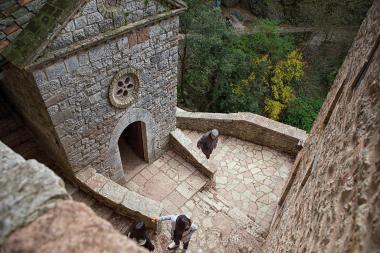
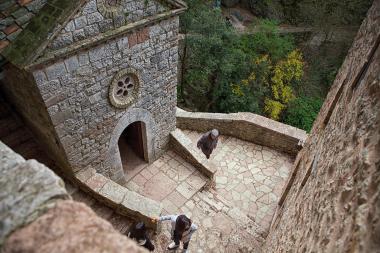
Near Pissignano lies the Hermitage of Sant’Antonio, built above a natural cave. Tradition says that Saint Francis of Assisi stopped here, as did the Blessed Ventura, who lived in the hermitage for over seventy years. Transformed in 1926 into a female Franciscan hermitage, it is now known as the House of the Larks of Saint Francis, guardians of a tradition of contemplation and simplicity.
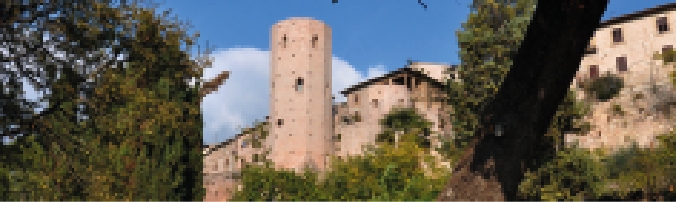
Beyond the castle of Campello Alto and the small hamlet of Lenano—whose name is said to derive from its two partially ruined 14th-century towers, nicknamed “the dwarfs”—the Via della Spina leads toward the Valnerina, revealing small treasures nestled in the folds of the mountains. Among them is the hamlet of Acera, the oldest settlement of the Spoleto area to become, in 1296, a true fortified village. Here one can still admire stretches of the original walls and a pentagonal tower from the 18th century, as well as the Church of San Biagio and the former Santa Maria Maggiore, now home to a small ethnographic centre dedicated to transhumance.
Further on lie the hamlets of Spina—divided into Old and New Spina, where once stood a now-lost castle—and finally Agliano, also known as the Rocca degli Alberici, built between the 14th and 15th centuries, with the Romanesque Church of San Pietro overlooking a landscape seemingly suspended in time.
Following instead the road crossing Mount Serano, one reaches Pettino, the highest village in the municipality, situated over a thousand metres above sea level. Its name, perhaps deriving from the Greek petinos (“bird”), evokes its ancient origins, confirmed by the presence of a Bronze Age castelliere. Pettino is home to the Churches of Saints Quirico and Giulitta, and that of Sant’Emidio, built in the 18th century by the Valenti Counts of Trevi. The community still participates in the celebration held every year on 10 July at the hermitage of San Paterniano, in the municipality of Sellano.