
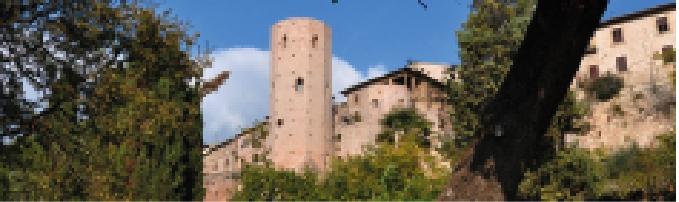

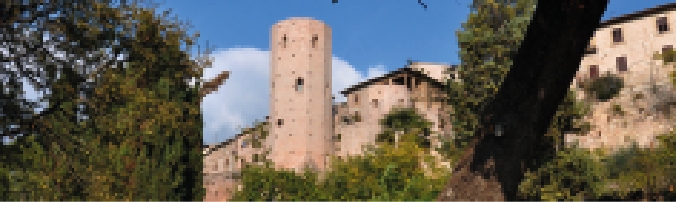

Castle of Pissignano Alto, with medieval towers and stone houses nestled among olive groves and wooded hills

Pissignano

Along the Via Flaminia that leads from Spoleto to Trevi, after passing the hamlet of La Bianca, lies the hamlet of Pissignano, with its important monuments rich in charm and history.

The modern settlement, enlivened each month by the famous Antiques, Second-Hand and Collectibles Market, which attracts visitors from all over Umbria, developed near the Clitunno Springs and the Tempietto sul Clitunno. A little higher stands the ancient medieval castle of Pissignano, perched on the hill that dominates the valley from which it originated.

The place name probably derives from the Latin Pissin-Ianum, meaning “pool of Janus,” whose etymology likely refers to the structures once located near the Clitunno springs, celebrated by Latin authors such as Pliny for their beauty and sacredness.


The birth of the medieval castle

Between the 11th and 12th centuries a primitive inhabited nucleus took shape near the present-day Church of San Benedetto, where a small Benedictine community lived. They were responsible for the construction of the defensive walls that defined the fortified layout of the settlement.

This early nucleus, also known as Colle Revaglioso or Borgo San Benedetto, was distinct from the actual fortress which, according to a tradition difficult to verify, is said to have been built on the western side of the hill by the German baron Sancio, who arrived in Italy following Emperor Conrad II and is considered the ancestor of the noble Sansi family.

Historical events of Pissignano

For centuries the castle of Pissignano was the subject of disputes between Foligno and Spoleto. In 1155 it hosted Frederick Barbarossa, who from here launched his attack on Spoleto, guilty of having deceived him by sending counterfeit coins instead of the 800 pounds of silver requested as war tribute.

In 1213 Duke Diopoldo, then lord of the area, donated the castle to Spoleto in exchange for help in his conflict with Trevi. The fortress thus became part of Spoleto’s possessions and was entrusted to the Sansi family. However, at the end of the 13th century a new conflict with Trevi caused the depopulation of Pissignano, to the extent that Spoleto promised privileges to anyone willing to settle again within its walls.

In 1395 Trevi’s troops sacked the castle, forcing the inhabitants to take refuge in the tallest tower, which was heroically defended by guards sent from Spoleto. Between the 15th and 16th centuries Pissignano was the scene of rebellions and assaults: here in 1580 the notorious bandit Pietrino Leoncilli barricaded himself, holding the entire Spoletino area in check for months.

Pissignano remained under Spoleto’s control until the 18th century, and today it is a quiet and prosperous hamlet of the municipality of Campello sul Clitunno.


The castle and the Church of San Benedetto

The castle of Pissignano, a typical example of a hillside fortress, is characterized by its triangular layout: at the top stands the tall, slender tower, symbol of the settlement’s power and resilience, while a second polygonal tower — once part of the defensive system — was later transformed into the bell tower of the Church of San Benedetto.

Near the castle stands the Church of San Cristoforo, later dedicated to Santa Maria della Misericordia due to a miraculous image of the Madonna preserved inside.

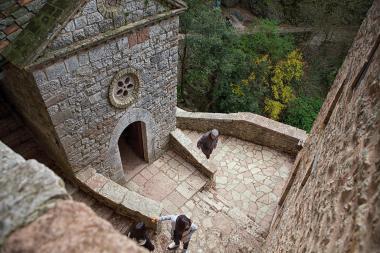
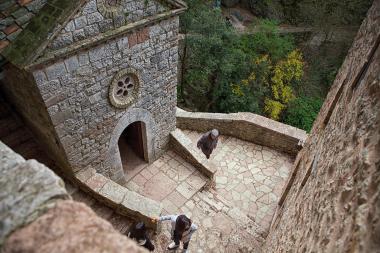
Near Pissignano lies also the Hermitage of Sant’Antonio, built above a natural cave and transformed in 1926 into a female Franciscan hermitage, today known as the House of the Larks of Saint Francis.

Explora los alrededores
Las principales atracciones cercanas