Avant le monastère de saint Pierre : la brève vie de Santa Croce
Le document le plus ancien cité dans les inventaires du XVIIIᵉ siècle est une bulle de Grégoire IX datée du 22 juin 1228, par laquelle certains privilèges sont accordés au Chapitre de la basilique de saint Pierre à Rome. Le texte, très bref, ne mentionne aucun lieu, mais sa présence pourrait représenter une prémisse institutionnelle liée au rôle du Chapitre de saint Pierre au Vatican, dont dépendront les fondations religieuses du XIVᵉ siècle.
Le 3 mai 1326, le Chapitre de saint Pierre autorisa, à la demande du frère augustin Gentile de Foligno et d’autres religieux (dont les Campellois fra Pace et Consolo), la fondation sous la règle augustinienne d’un monastère intitulé Santa Croce dans le territoire de Campello, dans un lieu nommé Seianum ou Sterleta.
Le terrain et les bâtiments avaient été donnés à la basilique vaticane par Vitale Petroni de Trevi, qui accorda des indulgences à ceux qui soutiendraient la construction du monastère.
La première fondation connue à Campello est donc liée à une communauté de moines, qui disparut cependant rapidement des sources : aucun document ultérieur n’en atteste la continuité, et la vie du monastère fut probablement de courte durée.
Le monastère de saint Pierre et la séparation d’Agnesuccia di Lorenzo
Quelques décennies après la fondation de Santa Croce naquit le monastère de saint Pierre, érigé par fra Pace di Morichitto da Campello avec l’autorisation du Chapitre de saint Pierre au Vatican (1330–1332).
Le monastère prospéra grâce à de nombreuses donations, dont celle de Lorenzo di Nicola (1385), qui légua des terres entre Poreta et Bazzano, peut-être liées à l’entrée de sa fille Agnesuccia parmi les moniales.
En 1397, Lorenzo di Nicola la nomma unique héritière alors qu’elle faisait encore partie de la communauté de saint Pierre. Trois ans plus tard, Agnesuccia obtint du pape Boniface IX l’autorisation de fonder, dans la maison paternelle, un nouveau monastère dédié à saint Jean-Baptiste, où elle pourrait se retirer avec trois consœurs, toujours sous la règle bénédictine. La fondation fut reconnue l’année suivante par l’évêque de Spolète, qui accorda une indulgence particulière à ceux qui contribueraient à sa construction.
Bien que les raisons de son départ restent inconnues, la cause doit être recherchée dans la revendication de l’héritage paternel par Agnesuccia, à laquelle les moniales de saint Pierre s’opposèrent fermement.
Les conflits concernant l’héritage paternel furent résolus en 1403 avec la restitution des terres à saint Pierre, tandis qu’Agnesuccia conserva la maison paternelle — désormais transformée en monastère de saint Jean-Baptiste, dont elle fut nommée abbesse — ainsi que le terrain adjacent destiné à devenir le cloître.
Événements ultérieurs et unification des deux monastères
Après le départ d’Agnesuccia, le monastère de saint Pierre traversa des années difficiles : en 1407, il entra en conflit avec l’évêque de Spolète pour des questions fiscales liées aux terres données, que les moniales durent racheter en payant 35 florins d’or. À partir de ce moment commença un lent déclin, avec un nombre toujours plus réduit de religieuses : en 1479, l’élection de l’abbesse Santuccia eut lieu en présence de seulement trois moniales.
Au contraire, le monastère de saint Jean-Baptiste connut une longue période de prospérité. Grâce à la sage administration de l’abbesse Agnesuccia — qui resta à la tête de la communauté au moins jusqu’en 1450 — et au soutien de nombreux bienfaiteurs, il s’enrichit rapidement tant en biens qu’en vocations. La faveur pontificale contribua également à en renforcer le prestige, y compris dans les controverses avec les habitants de Campello.
Entre la fin du XVᵉ et le XVIᵉ siècle, les informations se raréfient, en raison de la perte de nombreux documents, mais en 1585 le commissaire Giovanni Battista Corrado, chargé par le Chapitre de saint Pierre de percevoir les rentes provenant de l’Ombrie, mit en évidence une situation de déséquilibre : si dans le couvent de saint Jean-Baptiste vivaient quatorze moniales, celui de saint Pierre n’en comptait que dix, obligées de vivre dans une extrême pauvreté.
C’est ainsi qu’en 1604, l’évêque de Spolète décida d’unir les deux monastères sous la double titulature des saints Jean-Baptiste et Pierre, créant un complexe unique et, quatre ans plus tard, une nouvelle église.
Supprimé en 1810, le monastère fut acheté en 1935 par la Congrégation des Pères Barnabites, qui le transforma en résidence pour leurs étudiants en théologie. Il fut ensuite restauré à la suite du tremblement de terre de 1997 et rouvert comme Maison d’accueil et de prière.
Structure architecturale des deux couvents réunis par l’église de 1604
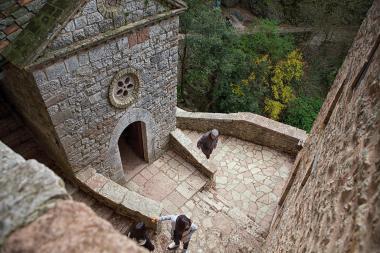
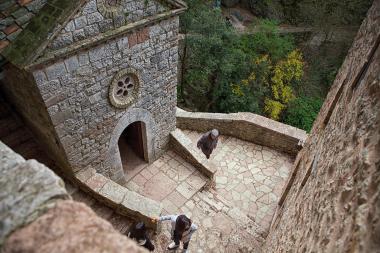
La partie la plus ancienne du complexe correspond au monastère dédié à saint Pierre, dont subsiste l’entrée originale avec son portail en pierre locale. À son extrémité se trouve l’église dédiée à sainte Marie des Anges, comme l’indiquent certains des fresques conservées en son intérieur.
L’église du monastère de saint Jean-Baptiste présentait l’autel appuyé au mur où se trouve aujourd’hui la fresque du Crucifix, et s’étendait jusqu’à une pièce attenante à l’escalier menant à l’étage supérieur, où subsistent encore quelques traces de fresques.
De longs et irréguliers couloirs relient les deux corps originaux, unifiés architecturalement et spirituellement également par l’église construite en 1608 sur le terrain situé entre les deux monastères.
À l’intérieur, le maître-autel baroque conserve une toile représentant l’Adoration des Mages, œuvre d’un peintre toscan du XVIIᵉ siècle, tandis que les deux autels latéraux montrent, à droite, une toile avec sainte Hélène, saint Charles et saint Antoine ; à gauche, une Vierge à l’Enfant avec saint Philippe Néri, toutes deux exécutées au XVIIIᵉ siècle.
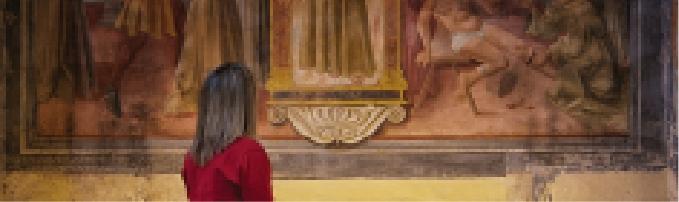
Le complexe conserve aussi d’intéressants témoignages artistiques médiévaux et renaissants, notamment une Crucifixion, œuvre du Maître de Fosse, flanquée de deux anges et de quatre saints en bas, surmontée d’une Nativité et d’une autre fresque représentant le Mariage mystique de sainte Catherine d’Alexandrie.
Le complexe conserve par ailleurs des fresques d’une grande importance, comme celle représentant la Vierge en trône avec l’Enfant, attribuée au Maestro di Eggi, ou celle où la Vierge accueille sous son manteau des moniales et saint François, attribuée à Lo Spagna.