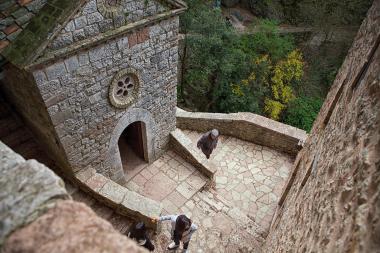

The Tempietto del Clitunno, a Lombard-era temple-shaped building with columns and a pediment, nestled in the greenery of the Umbrian countryside

Temple of Clitunno

In the hamlet of Pissignano, not far from the Clitunno Springs, stands a small building that seems suspended on the rocky spur on which it was built: the Tempietto del Clitunno, dedicated to San Salvatore.

Surrounded by cypress trees and reflected in the clear waters of the river, the Tempietto appears as the result of an encounter between Christian spirituality and classical elegance. Its position, perched on a rocky outcrop, makes it a privileged viewpoint over a landscape that has enchanted travellers and poets of every era.

As early as the 1st century AD, Pliny the Younger described with wonder the waters of the Clitunno and the tranquillity of the site—an atmosphere that has remained untouched over the centuries. During the Renaissance, this tiny temple became a source of inspiration for artists and architects: Palladio, Vanvitelli, Francesco di Giorgio Martini and Benozzo Gozzoli admired its perfect proportions. Lord Byron too was struck by it and celebrated its beauty in Childe Harold’s Pilgrimage, transforming the Tempietto into a symbol of an ancient and poetic Italy.

A deceptive appearance of a Roman temple

Its appearance strongly recalls that of a Roman temple: the harmonious proportions, the Corinthian colonnade and the refined reliefs deceived scholars and travellers for centuries, leading many to believe that it had been built on the remains of a temple dedicated to the god Clitumnus.

Today, however, many agree that its origins were Christian (according to some, built between the 4th–5th century, according to others between the 7th–8th). The Tempietto is the result of the architectural mastery of the Lombards, who created this monument by combining spolia from the Roman era with decorations that skillfully imitate the classical style.

Considered one of the most important early medieval monuments in Umbria, the Tempietto has been recognized as a UNESCO World Heritage Site within the serial property “The Lombards in Italy. Places of Power (568–774 AD).”

Architecture and decoration: between reuse and symbolism

The building has the appearance of a small tetrastyle in antis temple, with four Corinthian columns on the façade supporting an entablature bearing a dedication to the “God of the angels.”

The triangular pediment above, as well as the one at the rear, displays refined low-relief decoration with vine tendrils and grape clusters framing a Latin cross.

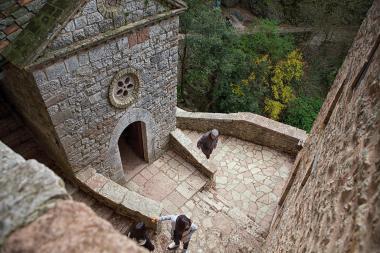
The Tempietto stands on a high podium housing a lower chamber. In the past, it was reached via two side stairways protected by small porticoes, while the interior opens onto a cella with a barrel vault, illuminated by symmetrically arranged windows. The masonry features irregular blocks and Roman spolia, perhaps taken from the ancient sanctuary dedicated to the god Clitumnus and mentioned by Pliny the Younger as once standing in this area.

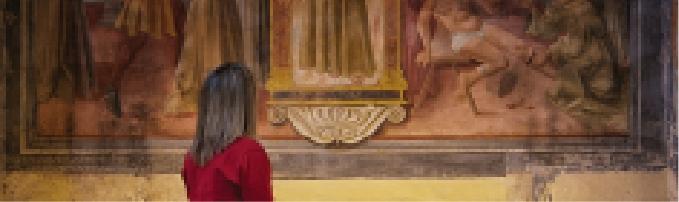
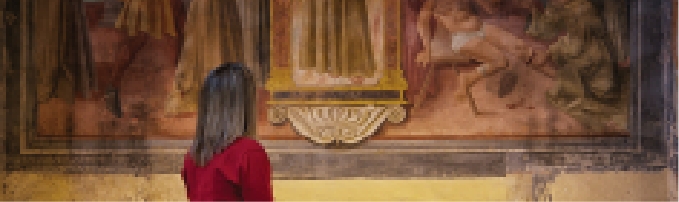
A small pronaos leads into the cella, where the rear wall’s apse contains a small aedicule-tabernacle with sculptural elements reused from the 1st century AD. Inside are preserved extraordinary frescoes, dated to the 7th–8th century and considered the oldest in Umbria: a blessing Christ in the apsidal dome, angels holding a gem-studded cross, and—on either side—Saint Peter and Saint Paul.

The Mill on the Clitunno

At the foot of the Tempietto stands the ancient mill built on the waters of the Clitunno, where some millstones dating back to the 14th century still remain, once used for the production of flour and oil.

Owned by the Municipality of Spoleto, it was destroyed in 1395 by the Trevi warlord Biordo de’ Michelotti during clashes between the two cities. It was later rebuilt by Spoleto’s governor Amorotto Condulmer in 1441, as indicated by the date engraved in the entrance lunette alongside the coats of arms of the municipality and the governor, who that same year also constructed an artificial canal to increase the water’s driving force.

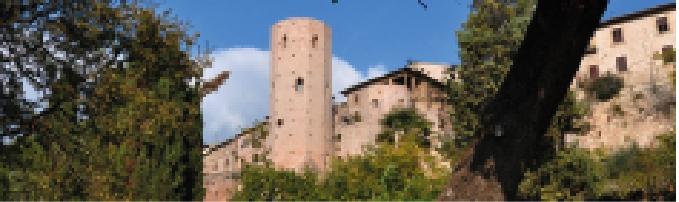
In 1520 the city of Spoleto, having forbidden the community of Campello from building a new mill on the Clitunno, faced the rebellion of the Brancaleoni family, who defied Spoleto’s authority by starting the construction of a second mill. openly ignoring all threats to desist, Girolamo Brancaleoni, known as Picozzo, rejected every order to surrender—even when threatened with exile or the death penalty—launching an assault on the castle of Pissignano and raiding the surrounding countryside.

The revolt continued until the intervention of Annibale Baglioni, papal commissioner, who stormed the fortress, defeated the rebels and ordered the destruction of the mill that had sparked the conflict.

Today, the mill of Pissignano—having been converted into a historic residence—awaits a new owner who can give it new life, enjoying a privileged view of the Tempietto del Clitunno.

Explore the surroundings
Main attractions in the vicinity