
Romanesque stone apse rising from a green meadow, with two cypress trees in the background under a blue sky.

Church of Saints Cyprian and Justina

Immersed in the quiet countryside of Campello sul Clitunno lie the remains of the Church of Saints Cyprian and Justina, a precious fragment of Umbrian Romanesque that has survived the centuries.

The building, now roofless and partially ruined, was erected between the 11th and 12th centuries in honour of Saint Cyprian, a Roman bishop of the 2nd century AD, and originally belonged to the Benedictine monks. For centuries it served as the parish church for the inhabitants of the small settlements surrounding the Clitunno Springs, until in the 19th century it lost its religious function and was converted into a cemetery—hence the popular name “Old Cemetery”.

Historical events

The church, likely built on an earlier structure, was first restored around 1100 by Bishop Salomone, and then again in the 14th century by the architect Giovanni da Prato, commissioned by Cardinal and Bishop of Spoleto Nicolò Alberti da Prato.

Over the centuries, however, the building suffered progressive destruction and abandonment. By the late 17th century it was already in ruins, and in 1825 the parish priest of Campello obtained permission to partially demolish its walls to reuse the material for the construction of the new parish house.

The ruins, overgrown with dense vegetation and almost entirely buried after decades of neglect, were unearthed and restored in 1995 by the Mountain Community of the Martani and Serano Mountains, in collaboration with the Superintendency for the Environmental, Architectural, Artistic and Historical Heritage of Umbria, which oversaw the architectural recovery of the apse.

The lost appearance of the ancient church

The church was originally built with regular rows of limestone blocks, featuring a simple gabled façade with an arched portal framed by two recessed mouldings.

At the opposite end opened an elegant semicircular apse—the only element that survived the 19th-century spoliation—divided by four stone pilasters topped with capitals supporting a series of hanging arches and a dentilled cornice, once designed to aid rainwater runoff. The apse roof was made of sandstone slabs.

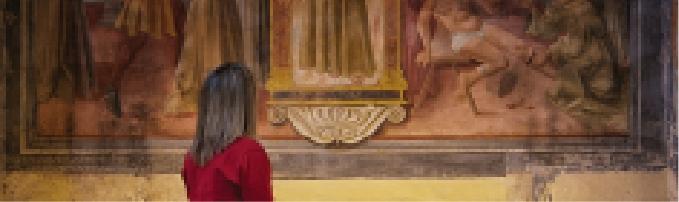
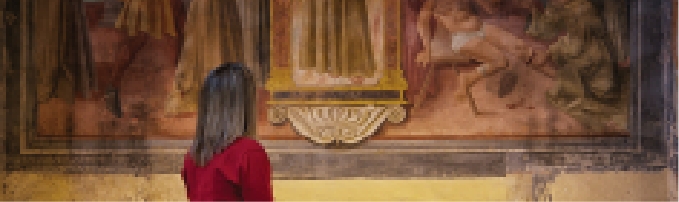
The interior, a single nave, was entirely decorated with 14th- and 15th-century frescoes of the Giotto school. These depicted Christ, the Madonna, Saint John the Evangelist, Saint Cyprian and Saint Justina. Today only faint traces of these paintings remain, faded but still visible in some sections of wall, bearing witness to an artistic past now almost lost.

Current appearance: perimeter walls and faded frescoes

Today, what remains of the ancient sacred building are its perimeter walls and part of the apse, still noble in its essentiality. The external half-columns end in small carved brackets. Inside, faint signs of ancient frescoes are still visible, almost dissolved by time, while the apse conch preserves traces of another fresco depicting the Crucifix between the Virgin Mary and Saint John the Evangelist.

Despite its ruinous state, the church preserves the integrity of its Romanesque plan, with a single nave and an east-facing apse, in keeping with the symbolic tradition of early Christian architecture. Next to the ruins, the former sacristy has also been restored and today houses a centre for the promotion of local products and serves as a starting point for nature excursions through the countryside and villages of Campello sul Clitunno.

Oratory of Saint Sebastian

A short distance from the Church of Saints Cyprian and Justina stands another place of worship: the Oratory of Saint Sebastian, built between 1522 and 1528 by the community of Campello as a votive offering after surviving the plague of 1514.

The building , simple and intimate, preserves inside several elegant depictions of Saint Sebastian — one on the altar, two on the right wall and three on the left —while in the apse stands out the refined 1527 fresco by the painter Giovanni di Pietro, known as Lo Spagna, showing the Madonna and Child within a mandorla supported by cherubs, flanked by devotional paintings of Saint Sebastian and Saint Roch, traditionally invoked as protectors against the plague.

Explore the surroundings
Main attractions in the vicinity