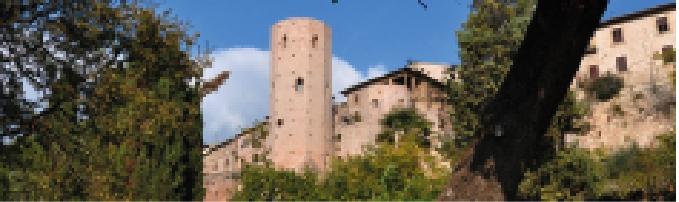
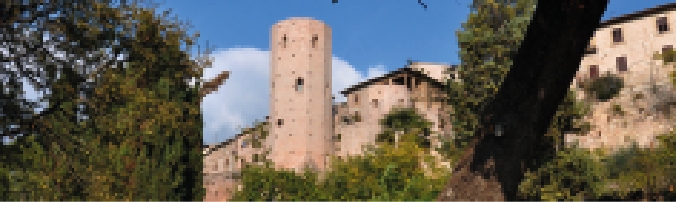

Castle of Acera nestled among the autumn woods of Umbria, with yellow and orange leaves framing the houses

Acera

Between the slopes of Monte Maggiore and Monte Grande, at nearly one thousand meters above sea level (972 m a.s.l.), lies Acera, one of the highest hamlets of Campello sul Clitunno. The village, surrounded by oak and maple woods — from which its name likely derives — overlooks the Spina valley from above, along the ancient route that linked the Umbra Valley with the Valnerina.

The road that passes through Acera was once an important transhumance route, used by shepherds and their flocks moving from the winter pastures of the Lazio Maremma to the summer pastures of the Umbrian–Marche Apennines. As early as 1468, the village hosted a small Hospitale, a shelter for shepherds and livestock on the move, evidence of its strategic role in the territory.

Origins 

The area of Acera has been inhabited since ancient times: archaeological findings from the nearby fortified settlement (castelliere) of Monte Serano, dating to the Late Bronze Age, attest to a stable presence already in prehistoric times.

The toponym itself may derive from acer, “maple,” once widespread in the woods of this region, or from arx, “fortress,” referring to the fortified nature of the site.

During Roman times, the slopes of Monte Maggiore were crossed by secondary routes connected to the Via Flaminia, linking Spoleto, Trevi and the upper Clitunno valley. However, it was only in the Middle Ages that Acera assumed a stable and recognizable role, becoming a fortified outpost controlling pastures and transhumance routes.

Birth of the castle

The foundation of the Castle of Acera dates back to the 13th century. A 1296 document mentions it as one of the earliest fortified villages of the Spoleto territory, governed by a podestà.

Over the centuries, the defenses were expanded and adapted to local needs. In the 16th century the castle had its own castellan and was included among the possessions of Lanfranco Campello, together with that of La Spina.

During the rebellion against Spoleto in 1522, Acera joined the uprising and managed to put up a fierce resistance for several days against the siege led by Andrea Pianciani, heir of Pietro Pianciani, active in the Spoleto area between 1327 and 1347. After the surrender, the village — together with La Spina — returned under Spoleto’s jurisdiction, later becoming definitively part of the Municipality of Campello sul Clitunno with the unification of Italy.

In the 18th century the noble Prioreschi family built a polygonal tower, incorporating the remains of a 14th-century rectangular tower and a 16th-century pentagonal one.

The fortification and its churches

Acera still preserves the typical layout of a perched medieval fortress, with a triangular plan featuring corner towers and a single gate facing the valley. Sections of the defensive walls, the main gate, and a 14th-century rectangular tower remain clearly visible, alongside the 18th-century pentagonal tower built by the Prioreschi family.

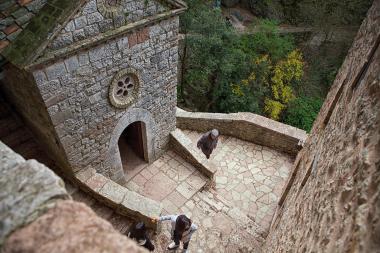
Inside the walls stands the Church of San Biagio, a small religious building likely constructed around 1296, at the same time as the castle’s foundation. Although altered over the centuries, the church still preserves simple yet valuable evidence of popular devotional art.

Near the entrance to the castle is the Church of the Madonna del Rosario, whose upper floor once belonged to a confraternity. It was later used as a school and, more recently, transformed into the Ethnographic Documentation Center on Transhumant Pastoralism. Nearby stands the public oven, a reminder of the village’s communal life.

Explore the surroundings
Main attractions in the vicinity